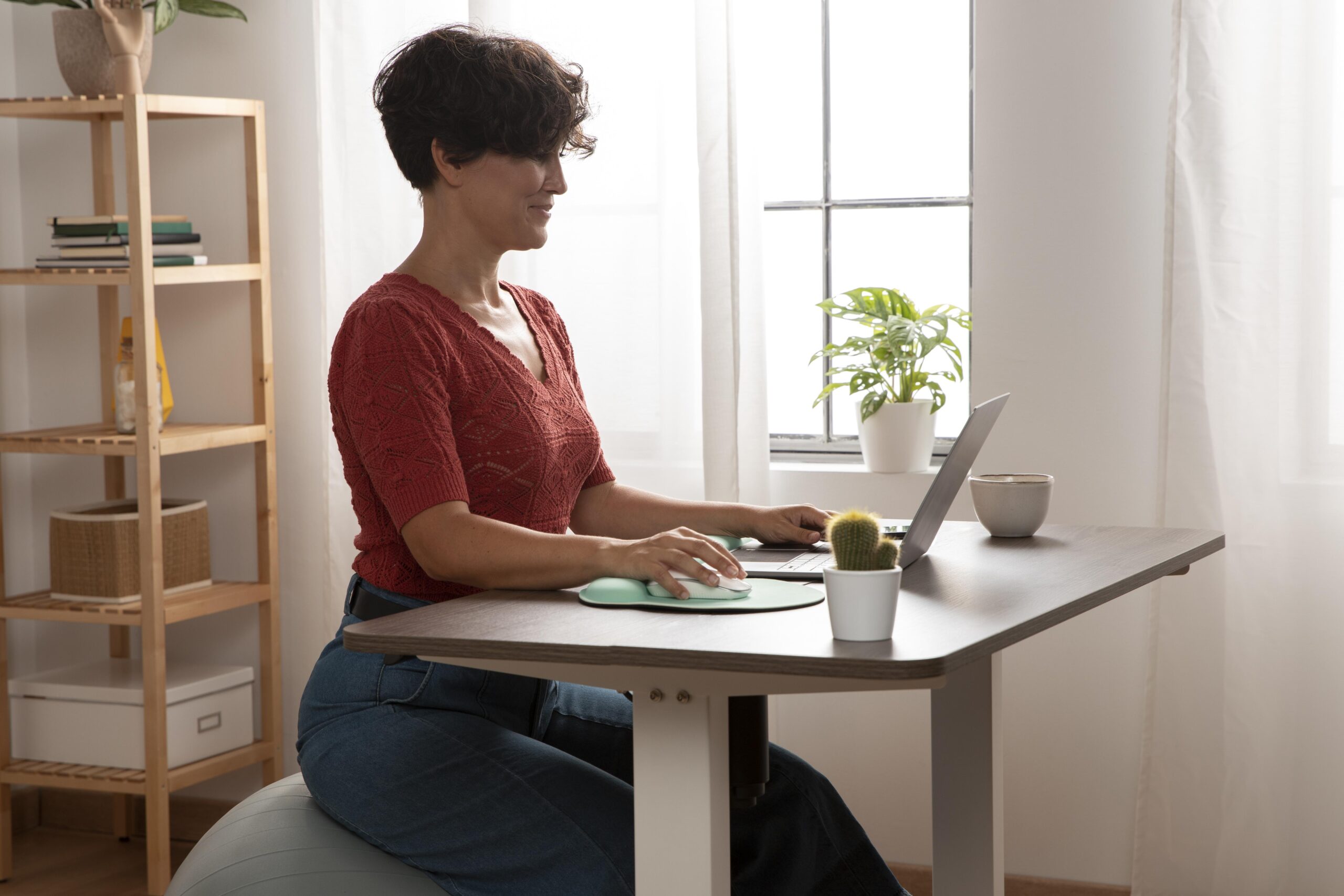
Posture Is Productivity: The Hidden Link Between How You Sit and How You Perform
You tell yourself you’ll start after this email.
Just one more message, one more update, and one more meeting before you stand up. Hours pass. The day blurs into tabs and to-dos. You’re doing everything right, yet something feels off. Your thoughts begin to drag, your work feels heavier, and you can’t explain why. Somewhere between the last email and the next meeting, your body forgot to move and your mind feels it. Each time you stay still a little longer, your output drops. Before you notice, your productivity has slipped through the cracks of routine.
We often think of productivity as a mental game of goals, motivation, and willpower.But here’s the twist. Your body and brain are deeply connected, constantly in conversation. Sit slouched and your brain gets a message of fatigue or defeat. Stand or sit upright, and your brain perks up with a message of alertness and confidence. That’s why even small posture shifts lead to measurable gains. Posture is not just about looking confident. It is one of the simplest ways to work smarter and feel stronger.
Your Brain Runs on Movement Not Caffeine
If you’re battling that slow fade of energy and focus at your desk, the solution might not be another cup of coffee. It could be as simple as how you’re sitting.Think about what happens the moment something demands your full attention. You take a deeper breath, straighten your spine, and lift your head. That instinctive shift isn’t just about looking engaged; it’s your body giving your brain more fuel.
When you slouch, you compress your lungs and diaphragm, reducing how much air you can take in. Less oxygen means less energy reaching your brain. Over long hours of deskwork, shallow breathing in that slumped position can literally dull your focus and drain your stamina.Now contrast that with an upright stance. Sitting or standing tall opens the chest and allows your lungs to expand fully. The result? A quick surge of oxygen and blood flow, a natural energy reset. It’s why even a brief stretch or standing break feels like clearing brain fog.
Research backs this up. In a 2023 BMC Public Health study, office workers who switched between sitting and standing during the day were about 6.5 percent more productive than when they remained seated all day.You don’t need to overhaul your entire routine. You’re not aiming for military posture or marathon standing sessions. All you need is just micro resets. A subtle lift through your chest, a gentle stretch, or a two-minute stand-up every hour is enough to reboot your body’s energy loop.
Think of it this way, if sitting all day is like running your laptop on power saver mode, then every time you stand, stretch, or straighten up, you’re plugging it back in for a quick recharge.Your posture doesn’t just reflect your productivity. It powers it.
Mood, Memory, and Stress: The Posture–Mind Connection
Posture doesn’t just affect focus and energy. It also shapes mood and mindset, two key drivers of sustained performance. Have you ever noticed that when you’re stressed or discouraged, your shoulders round and your back curls. That’s your body mirroring your mood. But it’s not a one-way street. Change your posture, and you can shift how you feel.
Research shows that posture and emotion are deeply intertwined. For example, participants in upright postures often report better mood, higher self-esteem, and lower negative emotion during challenging tasks compared to those who slouch (Nair et al. 2015). Their posture didn’t just shift their appearance. It shifted how they felt in the moment.
Posture also shapes the way your brain processes and recalls memories. In a 2017 experiment, students who sat upright recalled more positive memories, while those who slouched more easily recalled negative or discouraging ones (Peper et al., 2017). In other words, posture can tilt your mind toward either optimism or pessimism, shaping not just how you feel, but what you remember.
In stressful moments, posture also influences your emotional resilience. Research shows that adopting an upright and open posture during stressful tasks can reduce anxiety and improve composure (Nair et al., 2015). When your body stands tall and your chest is open, your nervous system interprets it as a position of safety and capability. It’s a subtle cue to your brain that you’re capable of handling what’s ahead.
The takeaway is simple. The way you sit or stand can reinforce how you think and feel. For desk professionals, that means your posture can either drain your motivation or help sustain it. Sit upright, breathe deeper, and you’ll notice your mindset follow. Less internal friction, more forward momentum.
The Hidden Productivity Shortcut
True productivity doesn’t begin with a new app, planner, or caffeine hit. It begins with your body. The way you move, sit, and breathe sets the rhythm for how clearly you think and how consistently you perform. When the afternoon fog rolls in, check in with your body before blaming your mind. A few seconds of movement, rolling your shoulders, standing tall, or taking a slow walk to refill your water can reignite clarity faster than any mental trick.
In the rush of modern work, it’s easy to forget that performance is physical. Every keystroke, idea, and decision flows through a body that needs alignment and movement to function at its best. A slumped posture quietly signals fatigue, while an upright, open one tells your brain it’s time to re-engage. Those subtle shifts create compounding gains, steadier energy, sharper focus, and more sustainable output.
This isn’t about how you look. It’s about building a physical foundation for lasting focus and confidence. Every small reset strengthens the connection between body and brain, creating a feedback loop of energy and confidence that grows with time. So when you catch yourself fading, don’t push harder, move smarter. Because sustainable productivity doesn’t start with effort, it starts with motion.
Ready to turn that awareness into action?
The Thrive Reset is a free weekly newsletter delivering one science-backed
30–60 second movement reset for desk professionals who want sustained focus, energy, and clarity.
Evidence References
(Because good movement advice should always be backed by good science.)
1. Wang, H., Xue, P., & Li, N. (2023). Quantifying the impacts of posture changes on office worker productivity: An exploratory study using effective computer interactions as a real-time indicator. BMC Public Health, 23, 17100. https://bmcpublichealth.biomedcentral.com/articles/10.1186/s12889-023-17100-w
2. Nair, S., Sagar, M., Sollers III, J., Consedine, N., & Broadbent, E. (2015). Do slumped and upright postures affect stress responses? A randomized trial. Health Psychology, 34(6), 632–641. https://pubmed.ncbi.nlm.nih.gov/25222091/
3. Peper, E., Lin, I.-M., Harvey, R., & Perez, J. (2017). How posture affects memory recall and mood. Biofeedback, 45(2), 36–41. https://www.researchgate.net/publication/321348063_How_Posture_Affects_Memory_Recall_and_Mood